Corfu

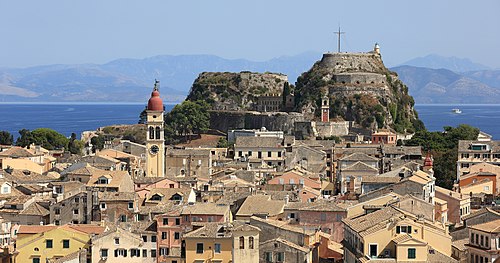
© This photo was taken by Anton Zelenov . Please credit... · CC BY-SA 4.0
Where Venetian boulevards meet Ionian coves, and every alley ends in a glimpse of the sea — Corfu is Greece with an Italian accent and a Greek heart.
Key facts
- Corfu is in the Ionian Islands, off western Greece.
- Best windows: May to June and September to October.
- Busiest period: July to August — peak season, highest prices and biggest crowds.
- Quietest months: November to March, when much of the season closes down.
- Signature dish: Pastitsada.
- The best way to explore beyond town is by rental car; buses serve the main villages and beaches but run infrequently on weekends.
- Book accommodation in Corfu Town if you want culture and nightlife; book on the west coast if you want beaches and sunsets.
The story of Corfu
The first thing you notice walking into Corfu Town is the light — not the hard white Cycladic glare, but a softer, golden quality that bounces off ochre walls and arched doorways. You round a corner and suddenly you are standing on the Spianada, one of the largest public squares in Europe, flanked by a cricket pitch and a row of arcades called the Liston that could be Paris if the palm trees gave it away. The Old Fortress rises on its promontory to your left, and beyond it the Ionian Sea shimmers in a shade of blue that belongs on a painter's palette. Corfu caught the attention of empires early. The Venetians stayed for four centuries and left behind fortresses, loggias, and a taste for sofrito and pastitsada that defines the island's table to this day. The French brought the boulevards. The British introduced cricket and ginger beer. And through it all, the Corfiot spirit remained — wry, musical, and fiercely proud of this island that has been a crossroads of civilisations since Odysseus washed up on its shores. Ferries from Igoumenitsa bring the Old Fortress into view across the water, which is where most visitors get their first sight of the island.
History
Corfu's history begins in myth. Homer called it Scheria, the island of the Phaeacians, where Odysseus was washed ashore and found by Nausicaa. The archaeological record tells a different but equally rich story: the island was settled by Eretrians from Euboea and later became a Corinthian colony under the name Korkyra. In the 7th century BC, Corfu fought the first recorded naval battle in Greek history against its mother city Corinth — a conflict Thucydides noted as a cause of the Peloponnesian War. The island's defining era began in 1386, when it passed into the hands of the Republic of Venice. The Venetians ruled for over four centuries — longer than any other power — and their influence is everywhere: the Old and New Fortresses, the narrow kampiela (alleys) that wind through the Old Town, the arcaded Liston, and the characteristic bell towers of every church. After Venice fell to Napoleon in 1797, Corfu passed briefly to France, then became the capital of the Septinsular Republic under Russo-Ottoman protection, and finally a British protectorate from 1815 to 1864. The British built roads, schools, and the Ionian Academy, and introduced cricket and ginger beer — both still thriving today. Corfu was united with Greece in 1864 as part of the Ionian Union, a moment still celebrated every year on 21 May. The Old Town was inscribed as a UNESCO World Heritage site in 2007, recognised as an outstanding example of Venetian fortification architecture.
What to see and do in Corfu
- Corfu Old Town (UNESCO) a labyrinth of Venetian kampiela, bell-towered churches, and pastel-coloured buildings that has changed little since the 16th century
- The Liston and Spianada the arcaded promenade and the vast esplanade it faces, where Corfiots gather for their evening volta
- Old Fortress a Venetian citadel on a rocky peninsula separating the town from the sea, built on a Byzantine foundation; the view from the top is worth every step
- New Fortress a later Venetian fortification on the hill of San Salvatore, with a network of underground tunnels and a panoramic terrace
- Achilleion Palace the neoclassical villa built for Empress Elisabeth of Austria (Sisi) in 1890, set in terraced gardens with statues of Achilles and a breathtaking view of the coast
- Paleokastritsa Monastery a 13th-century monastery perched on a headland above six coves of impossibly clear water, with a small museum of Byzantine icons
- Angelokastro a Byzantine castle on a 305-metre limestone peak on the northwest coast, one of the most important fortified sites in the Ionian
- Vlacherna Monastery and Pontikonisi the iconic white monastery on a tiny islet, with the tree-covered Mouse Island just offshore; the single most photographed view in Corfu
- Mount Pantokrator at 906 metres, the highest point on the island, with a 14th-century monastery at the summit and views stretching to the Albanian coast and mainland Greece
Things to book in Corfu
Booking · these are affiliate links · we may earn a commission, at no extra cost to you
Beaches and swimming
Corfu has more coastline than any other Ionian island, and its beaches range from organised resort strips to hidden pebble coves reachable only by boat. Paleokastritsa is the island's most famous beach destination — six distinct coves tucked into a lush green headland, each with a different character. The main beach has sunbeds, water sports, and a row of tavernas; the smaller coves to the north are quieter and better for snorkelling. Myrtiotissa, often called the most beautiful beach on the island, is a long stretch of soft white pebbles backed by green cliffs — it is also unofficially nudist-friendly. Agios Gordios is a long sandy beach framed by a dramatic rock formation called the Ortholithi, with a string of tavernas and a lively summer atmosphere. Glyfada, on the west coast, offers golden sand and organised beach clubs, popular with families and younger crowds. On the northwest coast, Sidari and Canal d'Amour draw visitors for the unusual sandstone rock formations carved by wind and sea into natural channels and pools — arrive early to avoid the crowds. For a proper escape, head to Halikounas on the south coast, a long stretch of sand backed by a freshwater lagoon where the swimming is calm and the crowds are thin. Or take a boat from Kassiopi to the remote coves of the northeast coast, where the water is so clear you can see the anchor chain to the bottom.
What to eat in Corfu
Corfiot cooking is unlike any other in Greece. Four centuries of Venetian rule left a lasting imprint on the island's kitchen, and the result is a cuisine that feels both familiar and distinctly its own. Pastitsada is the signature dish: rooster or beef slow-cooked in a rich tomato sauce spiced with cinnamon, allspice, and cloves, served over thick pasta — the Venetian influence is unmistakable in the sweet-spice profile. Sofrito is another Venetian legacy: thin veal escalopes simmered in a white wine and garlic sauce with parsley and a hint of lemon, served with rice or potatoes. From the sea comes bourdeto — a fiery fish stew made with scorpionfish or grouper in a tomato and chilli sauce that Corfiots eat with bread to mop up every last drop. Bianco is the gentler cousin: white fish poached in a lemon, garlic, and olive oil broth with potatoes, finished with fresh parsley. Tsigareli — wild greens (often vleeta or amaranth) sautéed with chilli and tomato — is the island's answer to spanakorizo and appears on every taverna table. And then there is the kumquat. Corfu is the only place in Europe where kumquats are cultivated commercially, introduced by British horticulturalists in the 19th century. Today you will find them candied, in liqueur, in marmalade, and spooned over ice cream. The local olive oil, made from the native Lianolia variety, is fruity and peppery. And a bottle of ginger beer — the British legacy, still produced locally by a handful of old bottlers — is the perfect non-alcoholic companion to a Corfiot lunch.
When to go
Late spring (May to June) and early autumn (September to October) are the sweet spots for Corfu. The weather is warm but not oppressive, the sea is swimmable, and the island is green and in bloom. Summer (July to August) is hot and busy, especially around the resorts of Sidari, Kavos, and Paleokastritsa, but the northern and western beaches offer space if you know where to go. Corfu is greener than most Greek islands, and in spring the countryside is covered in wildflowers and the scent of jasmine. Winter (November to March) is quiet and often rainy, but the Old Town has a melancholy charm in the low season, and tavernas in Corfu Town stay open year-round.
Getting there
Most visitors fly into Corfu Airport "Ioannis Kapodistrias" (CFU), a Fraport Greece airport roughly 3 km south of Corfu Town, with year-round scheduled links to Athens and Thessaloniki and a large summer charter programme from European cities. By sea, the mainland route runs from Igoumenitsa rather than Piraeus: Kerkyra Lines and Kerkyra Seaways operate conventional car ferries across in about 1 hour 10 minutes to 1 hour 30 minutes, several times a day all year. Italian services are largely seasonal — Grimaldi Lines from Brindisi in roughly 6 to 7 hours and ANEK Superfast's Blue Star from Bari in about 8 to 9 hours, with longer sailings from Ancona and Venice — and there is no direct scheduled Piraeus–Corfu ferry.
Practical tips
Corfu Town is compact and walkable, but the hills are steep — wear comfortable shoes. The best way to explore beyond town is by rental car; buses serve the main villages and beaches but run infrequently on weekends. If you drive, watch for the narrow kampiela in the Old Town where cars squeeze past pedestrians with inches to spare. Book accommodation in Corfu Town if you want culture and nightlife; book on the west coast if you want beaches and sunsets. The sunset from the Old Fortress is free, uncrowded, and better than any sunset cruise you can pay for. And when a Corfiot offers you kumquat liqueur after dinner, say yes — it is sweet, fragrant, and tastes exactly like this island feels.
Questions people ask about Corfu
When is the best time to visit Corfu?
Late spring (May to June) and early autumn (September to October) are the sweet spots for Corfu. The weather is warm but not oppressive, the sea is swimmable, and the island is green and in bloom.
What is Corfu best known for?
Corfu Old Town (UNESCO) — a labyrinth of Venetian kampiela, bell-towered churches, and pastel-coloured buildings that has changed little since the 16th century
Why visit Corfu?
Where Venetian boulevards meet Ionian coves, and every alley ends in a glimpse of the sea — Corfu is Greece with an Italian accent and a Greek heart.
What is the history of Corfu?
Corfu's history begins in myth. Homer called it Scheria, the island of the Phaeacians, where Odysseus was washed ashore and found by Nausicaa.
What is the story of Corfu?
The first thing you notice walking into Corfu Town is the light — not the hard white Cycladic glare, but a softer, golden quality that bounces off ochre walls and arched doorways. You round a corner and suddenly you are standing on the Spianada, one of the largest public squares in Europe, flanked by a cricket pitch and a row of arcades called the Liston that could be Paris if the palm trees gave it away.
What do people eat in Corfu?
Corfiot cooking is unlike any other in Greece. Four centuries of Venetian rule left a lasting imprint on the island's kitchen, and the result is a cuisine that feels both familiar and distinctly its own.
What should I know before visiting Corfu?
Corfu Town is compact and walkable, but the hills are steep — wear comfortable shoes. The best way to explore beyond town is by rental car; buses serve the main villages and beaches but run infrequently on weekends.
Where is Corfu?
Corfu is in Ionian Islands, Greece, at 39.6243° north, 19.9217° east.
How do you get to Corfu?
Most visitors fly into Corfu Airport "Ioannis Kapodistrias" (CFU), a Fraport Greece airport roughly 3 km south of Corfu Town, with year-round scheduled links to Athens and Thessaloniki and a large summer charter programme from European cities. By sea, the mainland route runs from Igoumenitsa rather than Piraeus: Kerkyra Lines and Kerkyra Seaways operate conventional car ferries across in about 1 hour 10 minutes to 1 hour 30 minutes, several times a day all year. Italian services are largely seasonal — Grimaldi Lines from Brindisi in roughly 6 to 7 hours and ANEK Superfast's Blue Star from Bari in about 8 to 9 hours, with longer sailings from Ancona and Venice — and there is no direct scheduled Piraeus–Corfu ferry.
Photographs of Corfu


Where Corfu is
Ionian Islands, Greece — 39.6243°, 19.9217°


