Tinos

Public domain · JFKennedy
The sacred island of the Aegean, home of the miracle-working icon of the Panagia, with marble villages, dovecote towers, and a beauty that is both spiritual and wild.
Key facts
- Tinos is in the Cyclades, the island group in the central Aegean.
- Best window: May, June.
- Busiest period: July and August — peak season, highest prices and biggest crowds.
- The pilgrimage path and the church deserve your time — dress respectfully, and be aware that 15 August is extraordinarily busy.
The story of Tinos
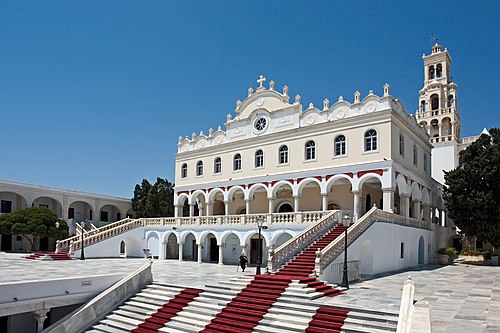
Tinos is the holiest island of the Aegean, and its atmosphere is unlike any other. The great harbour is dominated by the white church of the Panagia Evangelistria, and pilgrims climb the marble path from the port to the church — many on their knees, some crawling the last steps, in fulfillment of vows. The basilica is the most important pilgrimage church in Greece, and its courtyards and marble decorations are extraordinary. But Tinos is more than a pilgrimage: it is an island of astonishing beauty, famous for its marble craftsmanship and its dovecote towers, hundreds of elegant white towers with patterned fronts that were once used to raise pigeons. Pyrgos, the marble capital of Greece, is where the workshops of the sculptors still turn out work in the island's famous stone, while Volax, a village of grey stone houses in a field of giant boulders, lies further out. Agios Romanos offers a beautiful beach of pale sand. Tinos is a place of faith, art, and wild, austere beauty — an island that stays with visitors long after they leave.
History
Tinos has been inhabited since antiquity, and its most remarkable story began in 1823, when a nun called Pelagia had visions on 9, 16 and 23 July of the previous year and showed the islanders where a buried icon of the Virgin lay. It was unearthed on 30 January 1823 by Dimitris Vlassis of Falatada, and the church was finished in 1830. The icon was found, a church was built to house it, and Tinos became the Lourdes of Greece — a place of pilgrimage that draws hundreds of thousands of visitors every year, especially on 15 August, the feast of the Assumption, when the island is filled with pilgrims. The icon of the Panagia Evangelistria has been credited with countless miracles, and the church and its courtyards are among the most important religious sites in Greece. Tinos is also famous for its marble: the island's quarries and its master sculptors supplied marble and sculpture across Greece, and the villages of Pyrgos and Isternia are still centres of the craft. The island's dovecote towers — more than 700 of them, many dating from the 17th and 18th centuries — are a unique feature of its landscape. In the 19th and 20th centuries, Tinos was a quiet, devout island of farmers, shepherds, and marble workers, and it has kept that character today, even as its beautiful beaches have made it a favourite of travellers.
Myths and legends
The name is recorded by Stephanus of Byzantium in the sixth century AD. His Ethnica is not a book of stories but a dictionary of Greek place-names, and for this one it says: "It is named from its founder Tinos". "It was also called Hydroessa because it is very rainy". (Ethnica, s.v. Τῆνος).
That is the whole of what an ancient source has to say about how the place got its name. It is a shorter answer than the guidebooks give, and it is the only one with a source behind it.
What to see and do in Tinos
- The Panagia Evangelistria the great pilgrimage church of Tinos, with its marble courtyards, the miraculous icon, and the extraordinary atmosphere of faith
- Pyrgos the marble capital of Greece, a beautiful village of marble-paved lanes, sculptors' workshops, and the museum of the island's great sculptors
- Volax a village of grey stone houses set in a surreal field of giant boulders, one of the strangest and most beautiful villages in Greece
- The dovecote towers hundreds of elegant white dovecotes with patterned fronts, a unique feature of the Tinian landscape
- Kionia and the ancient sanctuary the ruins of the ancient sanctuary of Poseidon and Amphitrite on the coast
- Agios Romanos and the beaches of the south beautiful sandy beaches with calm water
- Isternia a pretty mountain village famous for its potters and its views
- The marble path and the festivals the marble street from the port to the church, and the great festival of 15 August, when the island is filled with pilgrims
Things to book in Tinos
Booking · these are affiliate links · we may earn a commission, at no extra cost to you
Beaches and swimming
Tinos has a long southern coast with some of the most beautiful beaches of the northern Cyclades. Agios Romanos, on the southwest, is a long stretch of pale sand with clear water and a few tavernas. Kolymbithra, on the north, is a pair of pretty coves backed by cliffs. Kionia, near the ancient sanctuary, is convenient and family-friendly. And the beaches of the west coast — Panormos, Rochari, and the little coves below the hills — are quiet and beautiful. The water is clear and calm, and the swimming is gentle and pleasant. Tinos offers the beauty of the famous islands without the crowds, and its beaches reward those who take the time to find them.
What to eat in Tinos
Tinos is famous for its food. The island produces excellent cheese, especially the fresh, tangy kopanisti, and its honey and its marble-sweet figs are celebrated. The island's tavernas serve the classic Cycladic table — grilled fish, octopus, and the local cheeses — with an honest, rural warmth. The local specialities include the island's sausage, its wild greens, and the delicious sweets of its villages. For a real Tinos meal, order the kopanisti with bread, the fish of the day, and a plate of the island's figs for dessert, and eat slowly in one of the island's friendly tavernas. Tinos food is the cooking of a devout, hard-working island — simple, generous, and full of character.
When to go
May, June, and September are the best months on Tinos: warm, quiet, and beautiful, with the pilgrimage crowds gone and the beaches calm. July and August are busier, especially around 15 August, when the island is packed with pilgrims and visitors. Spring is lovely, with wildflowers, and the island's austere beauty is striking in the low light of autumn. Whenever you come, visit the Panagia with respect — it is a place of deep faith — and give the rest of the island time to reveal its marble villages, its dovecotes, and its wild coasts.
Getting there
Tinos has no airport, only a heliport at Agios Fokas, so almost everyone arrives by sea. The fastest sailing is from Rafina, at about an hour and a half, while the trip from Piraeus is considerably longer; flying to Mykonos or Syros and taking a short ferry hop is the other option.
Practical tips
A car or scooter is the best way to explore the island's villages and beaches. Visit Pyrgos and its workshops, see the boulders of Volax, and drive to the beaches of the south. The pilgrimage path and the church deserve your time — dress respectfully, and be aware that 15 August is extraordinarily busy. Buy a piece of Tinian marble or a jar of the island's honey to take home, and allow Tinos to show you its quiet, devout, beautiful heart.
Questions people ask about Tinos
When is the best time to visit Tinos?
May, June, and September are the best months on Tinos: warm, quiet, and beautiful, with the pilgrimage crowds gone and the beaches calm. July and August are busier, especially around 15 August, when the island is packed with pilgrims and visitors.
What is Tinos best known for?
The Panagia Evangelistria — the great pilgrimage church of Tinos, with its marble courtyards, the miraculous icon, and the extraordinary atmosphere of faith
Why visit Tinos?
The sacred island of the Aegean, home of the miracle-working icon of the Panagia, with marble villages, dovecote towers, and a beauty that is both spiritual and wild.
What is the history of Tinos?
Tinos has been inhabited since antiquity, and its most remarkable story began in 1823, when a nun called Pelagia had visions on 9, 16 and 23 July of the previous year and showed the islanders where a buried icon of the Virgin lay. It was unearthed on 30 January 1823 by Dimitris Vlassis of Falatada, and the church was finished in 1830.
What is the story of Tinos?
Tinos is the holiest island of the Aegean, and its atmosphere is unlike any other. The great harbour is dominated by the white church of the Panagia Evangelistria, and pilgrims climb the marble path from the port to the church — many on their knees, some crawling the last steps, in fulfillment of vows.
What do people eat in Tinos?
Tinos is famous for its food. The island produces excellent cheese, especially the fresh, tangy kopanisti, and its honey and its marble-sweet figs are celebrated.
What should I know before visiting Tinos?
A car or scooter is the best way to explore the island's villages and beaches. Visit Pyrgos and its workshops, see the boulders of Volax, and drive to the beaches of the south.
Where is Tinos?
Tinos is in Cyclades, Greece, at 37.5383° north, 25.1661° east.
How do you get to Tinos?
Tinos has no airport, only a heliport at Agios Fokas, so almost everyone arrives by sea. The fastest sailing is from Rafina, at about an hour and a half, while the trip from Piraeus is considerably longer; flying to Mykonos or Syros and taking a short ferry hop is the other option.
Photographs of Tinos


Where Tinos is
Cyclades, Greece — 37.5383°, 25.1661°


